
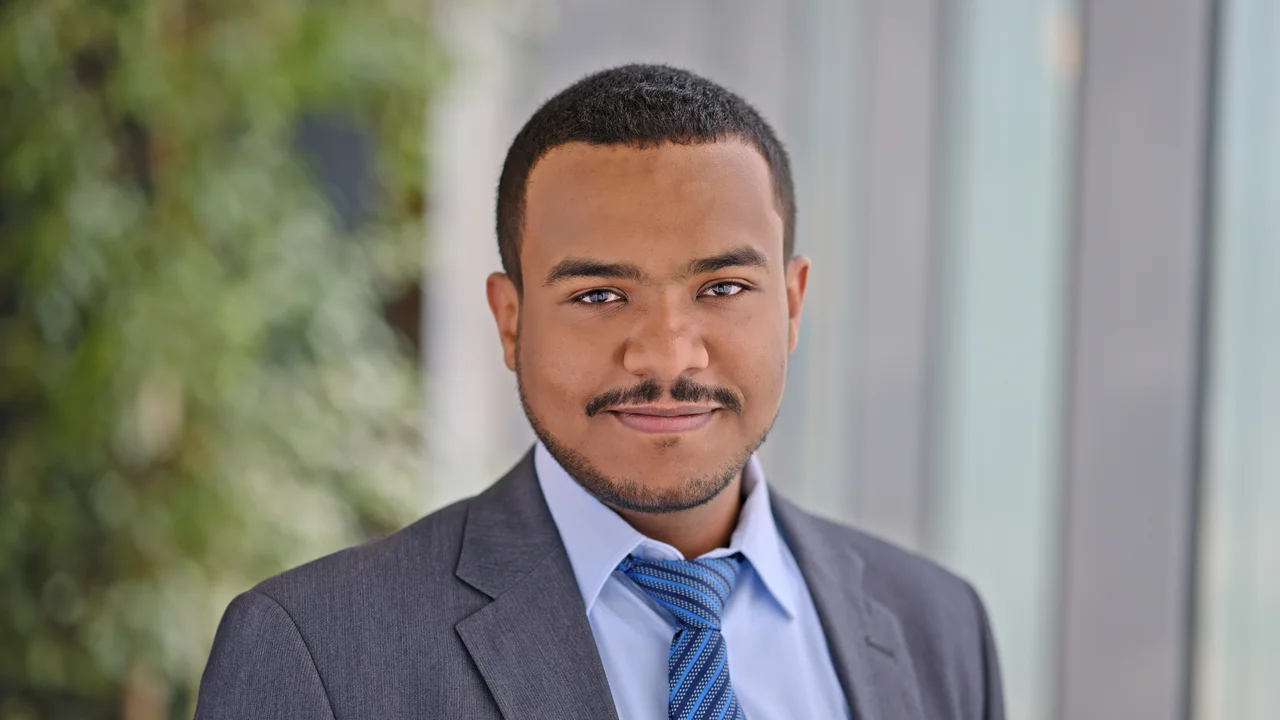
Elsiddig Awadelkarim Elsiddig successfully defended his PhD Thesis
On March 26, 2025, Elsiddig Awadelkarim Elsiddig successfully defended his PhD Thesis entitled "Some Contributions to Particle and Unbiased Simulation Methods".
About
Abstract:
In this thesis we study Feynman-kac formulae, estimation and sampling problems. We propose estimators that are formulated using Feynman-Kac formulae and unbiased techniques for several problems such as estimation, filtering, and sampling. In Chapter 3 we consider the estimation of static parameters for partially observed diffusion process with discrete-time observations over a fixed time interval where we assume that one must time-discretize the partially observed diffusion process and work with the model with bias and consider maximizing the resulting log-likelihood. Using a novel double randomization scheme, based upon Markovian stochastic approximation we develop a new method to, under appropriate assumptions, unbiasedly estimate the static parameters, that is, to obtain the maximum likelihood estimator with no time discretization bias. In Chapter 4 we consider the filtering problem associated to partially observed McKean-Vlasov stochastic differential equations (SDEs). These are an important class of processes, which frequently appear in applications such as mathematical finance, biology and opinion dynamics. The model we investigate consists of data that are observed at regular and discrete times and the objective is to compute the conditional expectation of (functionals) of the solutions of the SDE at the current time. We develop a new particle filter (PF) and multilevel particle filter (MLPF) to approximate the afore-mentioned expectations. We prove under assumptions that, for ε > 0, to obtain a mean square error of O(ε² ) the PF has a cost per-observation time of O(ε⁻⁵ ) and the MLPF costs O(ε⁻⁴) (best case) or O(ε⁻⁴ log(ε)²) (worst case). In Chapter 5 we examine the numerical approximation of the limiting invariant measure associated with Feynman-Kac formulae. These are expressed in a discrete time formulation and are associated with a Markov chain and a potential function. The typical application considered is the computation of eigenvalues associated with non-negative operators . We focus on a novel lagged approximation of this invariant measure. This estimator and its approximation using Diffusion Monte Carlo (DMC) are commonly used in the physics literature. We prove the almost sure characterization of the L1-error O(exp{−κl}/N ) for κ > 0 as the time parameter (iteration) goes to infinity. Furthermore we prove the non-asymptotic in time, and time uniform L1− bound O(l/ √N ). We also prove a novel central limit theorem to give a characterization of the exact asymptotic in time variance. This analysis demonstrates that this strategy that is used in physics literature is mathematically justified. In Chapter 6 we consider the development of unbiased estimators, to approximate the stationary distribution of Mckean-Vlasov stochastic differential equations (MVSDEs). Typically the stationary distribution is unknown and one cannot simulate such processes exactly. As a result one commonly requires a time-discretization scheme which results in a discretization bias and a bias from not being able to simulate the associated stationary distribution. To overcome this bias, we present a new unbiased estimator taking motivation from the literature on unbiased Monte Carlo. We prove the unbiasedness of our estimator, under assumptions. In order to prove this we require developing ergodicity results of various discrete time processes, through an appropriate discretization scheme, towards the invariant measure. Our theoretical findings are corroborated by numerical simulations.
Advisors:
Prof. Ajay Jasra, and Prof. Raúl Tempone
Committee Members:
Prof. David Bolin, Prof. Diogo A. Gomes, and Prof. Adam Johansen
Related People
Alumni
Elsiddig Awadelkarim Elsiddig
- Postdoctoral Research Fellow, Statistics