
Article "Multi-Iteration Stochastic Optimizers" published in Applied Mathematics & Optimization
About
The article “Multi-Iteration Stochastic Optimizers” by André Carlon, Luis Espath, Rafael Holdorf, and Raúl Tempone has been published in Applied Mathematics & Optimization. The paper introduces a new class of first-order stochastic optimization methods based on the Multi-Iteration stochastiC Estimator (MICE). The central idea is to reuse gradient information collected along the optimization path through successive control variates. By exploiting correlations between nearby iterates, MICE reduces the variance of stochastic gradient estimates while keeping the additional sampling cost under control.
This makes MICE particularly useful for optimization problems in which gradients are expensive, noisy, or estimated through Monte Carlo sampling, including applications in stochastic optimization, uncertainty quantification, machine learning, and simulation-based design. Since MICE is designed as a non-intrusive gradient estimator, it can be combined with standard first-order optimizers such as SGD, Adam, and related methods. The paper provides theoretical error and convergence analyses, including results for strongly convex problems and some non-convex settings, and demonstrates the method on benchmark stochastic optimization and logistic regression problems.
The implementation is openly available at the MICE repository: https://github.com/agcarlon/mice. The package can be installed directly from PyPI using
pip install mice
The published article is available at: https://link.springer.com/article/10.1007/s00245-026-10451-x
Abstract:
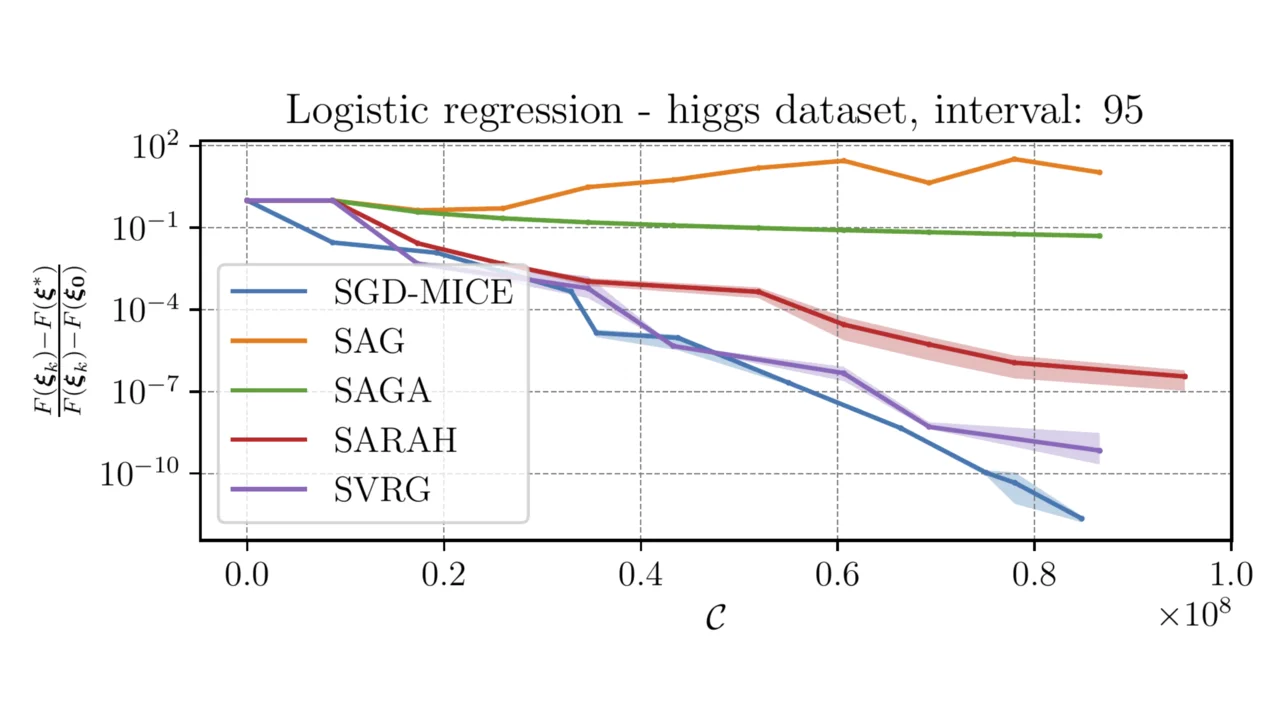
We introduce Multi-Iteration Stochastic Optimizers, a novel class of first-order stochastic methods that control the relative L2 error using successive control variates along the iteration path. By exploiting correlations between iterates, these control variates reduce the estimator’s variance, making an accurate mean gradient estimation computationally affordable. Our approach centers on the Multi-Iteration stochastiC Estimator (MICE), which can be seamlessly coupled with any first-order stochastic optimizer due to its non-intrusive design. The algorithm adaptively selects which iterates to include in its index set. We provide both an error analysis of MICE and a convergence analysis for Multi-Iteration Stochastic Optimizers across various problem classes, including some non-convex cases. In the smooth, strongly convex setting, we demonstrate that to approximate a minimizer within a tolerance tol, SGD- MICE requires, on average, O(tol−1) stochastic gradient evaluations, compared to O(tol−1 log(tol−1)) for SGD with adaptive batch sizes. In numerical experiments, SGD-MICE achieved the desired tolerance with fewer than 3% of the gradient evaluations required by adaptive batch SGD. Additionally, MICE offers a straightforward stopping criterion based on the gradient norm, validated through consistency tests. To assess its efficiency, we present examples using both SGD-MICE and Adam-MICE, including a stochastic adaptation of the Rosenbrock function and logistic regression on various datasets. Compared to SGD, SAG, SAGA, SVRG, and SARAH, our approach consistently reduces the gradient sampling cost without the need for extensive parameter tuning.
Related People
Related Researchers


André Gustavo Carlon
- Postdoctoral Research Fellow, Stochastic Numerics Research Group

Luis Espath
- Postdoctoral Research Fellow, Stochastic Numerics Research Group