
Preprint in Optimization and Control from our research team
About
The Stochastic Numerics Group would like to highlight the recent achievement within our research group. We are pleased to announce that our paper, "Pontryagin-Based Solver with Smoothed Hamiltonian, Adaptive Δt, and PA-Bundle Refinement," has been published as an arXiv preprint. The authors of this paper are KAUST M.S. student Salim Ksous, Ph.D. student Sebastien Lalvay Segovia, Research Scientist Erik von Schwerin, PI Raúl Tempone, and Professors Mattias Sandberg and Anders Szepessy from KTH Royal Institute of Technology. We would like to congratulate the authors on this collaborative achievement.
Our research presents a new numerical solver for deterministic optimal control problems based on the Pontryagin Maximum Principle. Indirect methods built on Pontryagin's framework are well known for their high accuracy but can be difficult to apply in practice due to nonsmooth Hamiltonians and the numerical challenges of solving the resulting two-point boundary value problems.
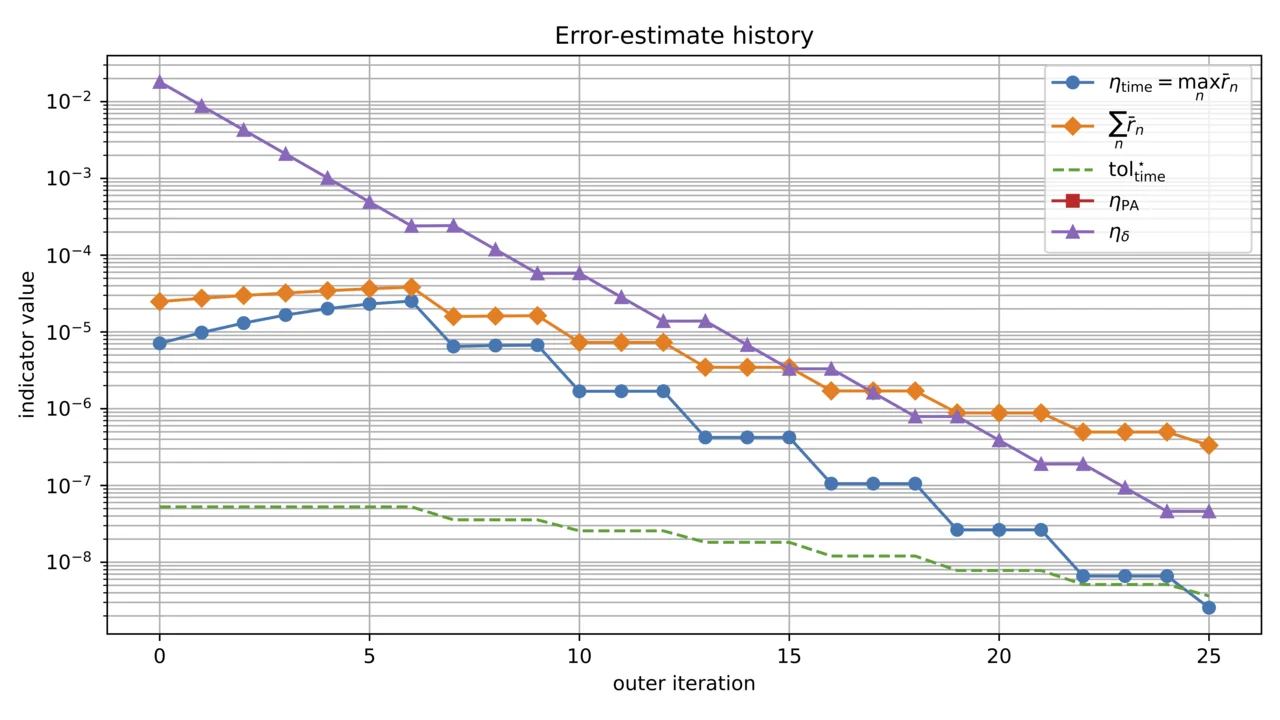
To address these challenges, we develop a Pontryagin-based solver that regularizes the Hamiltonian through a smooth log-sum-exp approximation of a piecewise-affine bundle surrogate, producing a smooth optimization problem while preserving the essential structure of the original control problem. The resulting optimality system is discretized using a symplectic Euler scheme and solved efficiently with damped Newton iterations. A unified adaptive strategy simultaneously controls the time-step distribution, the complexity of the bundle approximation, and the smoothing parameter, allowing the solver to automatically balance computational cost and solution accuracy. Through a diverse collection of benchmark problems—including nonsmooth, singular, hypersensitive, and quadratic-programming-oracle examples—we demonstrate the robustness and effectiveness of the proposed methodology, with a linear–quadratic regulator serving as a calibration benchmark against the exact Riccati solution.
For those interested in learning more about this work, the preprint is available here.
We are excited about the potential impact of our findings on numerical optimal control and scientific computing and look forward to further exploring and expanding upon this research. Stay tuned for more updates from our team!
ABSTRACT:
We present a Pontryagin-based numerical solver for deterministic optimal control problems in Bolza form. The solver regularizes the generally nonsmooth Hamiltonian using a log-sum-exp smoothing of a concave piecewise-affine bundle surrogate, yielding a smoothed Hamiltonian Hδ that is C∞ and concave in the costate and C1,1 in the state. The resulting two-point boundary value problem is discretized by a symplectic Euler scheme and solved by damped Newton iteration on the full-space nonlinear system in the discrete state and costate variables. A unified adaptive outer loop jointly controls the time-step distribution Δt, the number of planes in the bundle surrogate, and the smoothing parameter δ. The time-adaptation strategy follows the error-density framework of Karlsson, Larsson, Sandberg, and Tempone (2015). Related approaches include Pontryagin shooting, Hamilton–Jacobi–Bellman methods, occupation-measure relaxations, max-plus approximations, and direct collocation. Numerical examples, including nonsmooth, singular, hypersensitive, and quadratic-programming-oracle benchmarks, demonstrate the roles of time refinement, bundle enrichment, and smoothing continuation. A linear–quadratic regulator with a closed-form Riccati solution is used as a calibration check.