
Article "Goal-Oriented Adaptive Finite Element Multilevel Quasi-Monte Carlo" published in the Journal of Computational Physics
About
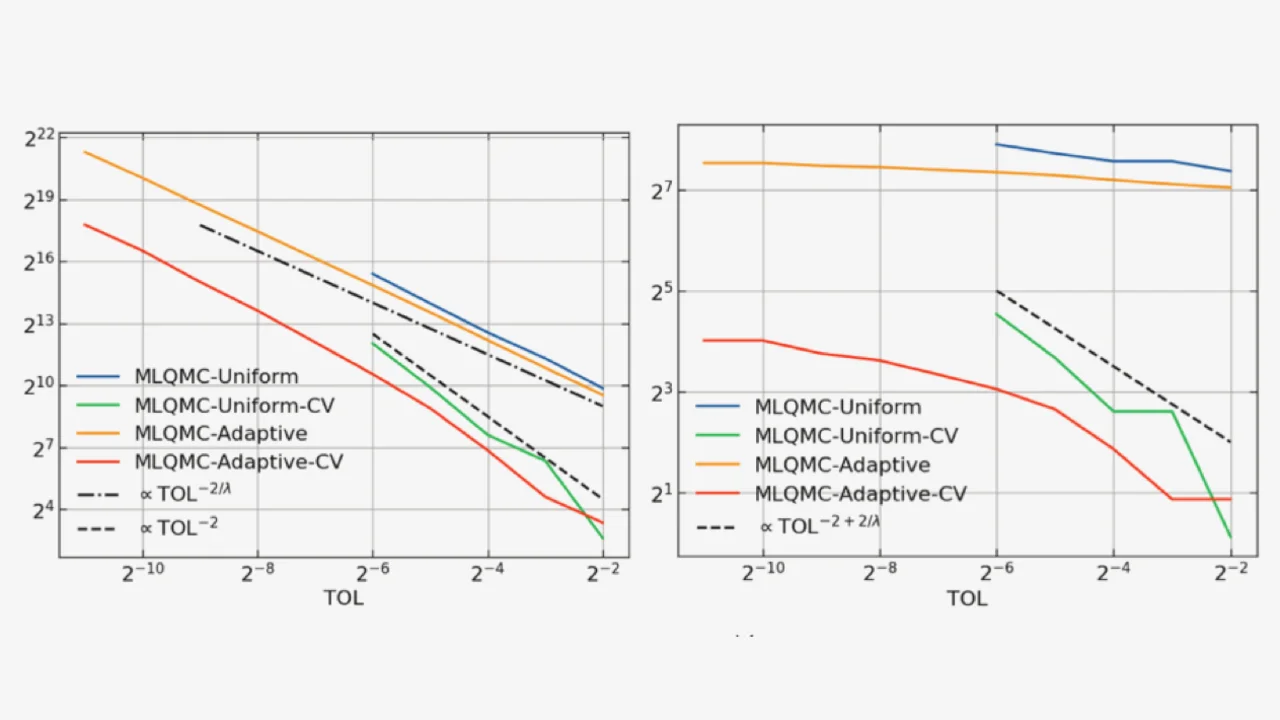
The article "Goal-Oriented Adaptive Finite Element Multilevel Quasi-Monte Carlo" by Joakim Beck, Yang Liu, Erik von Schwerin, and Raúl Tempone has been published in the Journal of Computational Physics. This paper develops a goal-oriented adaptive finite-element multilevel quasi-Monte Carlo method for estimating quantities of interest in elliptic PDEs with lognormal random coefficients and geometric singularities. The framework combines sample-dependent adaptive meshes with MLQMC sampling, importance sampling, and a level-zero control variate, while addressing the resulting parameter-space discontinuities through a parametric regularity analysis. Numerical experiments show that it achieves a prescribed accuracy at substantially lower computational cost than standard multilevel Monte Carlo.
Abstract:
The efficient approximation of quantities of interest derived from PDEs with lognormal diffusivity is a central challenge in uncertainty quantification. This paper targets a problem class that combines four analytical difficulties: a geometric boundary singularity, a lognormal coefficient field without a deterministic positive lower bound, sample-dependent mesh selection that introduces parameter-space discontinuities, and infinitely many discontinuity locations that preclude classical pre-integration smoothing. In this study, we propose a multilevel quasi-Monte Carlo framework to approximate deterministic, real-valued, bounded linear functionals that depend on the solution of a linear elliptic PDE with a lognormal diffusivity coefficient parameterized by a multi-dimensional Gaussian random vector and deterministic geometric singularities in bounded domains of \mathbb{R}^d. We analyze the parametric regularity and develop the multilevel implementation based on a sequence of adaptive meshes, developed in our earlier work “Goal-oriented adaptive finite element multilevel Monte Carlo with convergence rates”, CMAME, 402 (2022), p. 115582. For further variance reduction, we incorporate importance sampling and introduce a level-0 control variate within the multilevel hierarchy. Introducing such a control variate can alter the optimal choice for the initial mesh, further highlighting the advantages of adaptive meshes. On a 2-D slit benchmark discretized with bilinear, quadrilateral Q1-FEM, numerical experiments show that, in the parameter range explored, the proposed adaptive MLQMC algorithm achieves a prescribed accuracy at markedly lower computational cost than a standard multilevel Monte Carlo estimator on the same mesh hierarchy.
Related People
Related Researchers

Yang Liu
- Postdoctoral Research Fellow, Applied Mathematics and Computational Science



Joakim Beck
- Research Scientist, Stochastic Numerics Research Group