
Article "Multi-index importance sampling for McKean–Vlasov stochastic differential equations" published in the Journal of Computational and Applied Mathematics
About
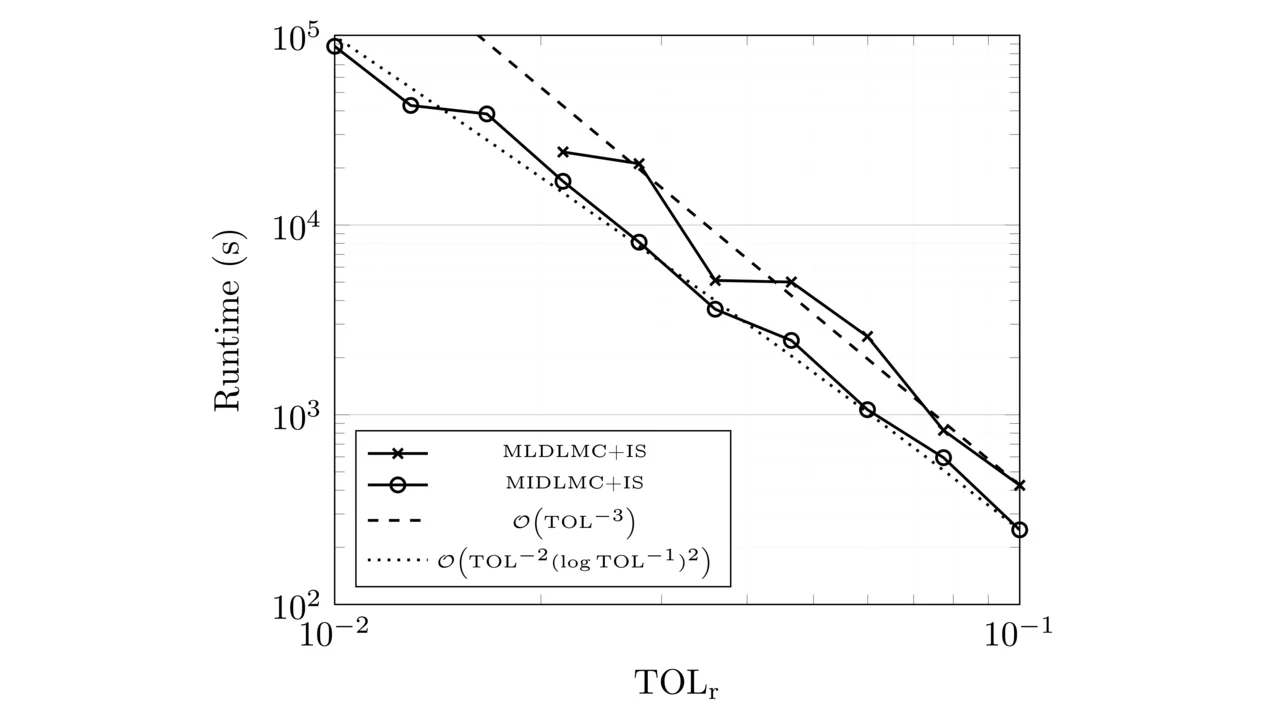
The article "Multi-index importance sampling for McKean–Vlasov stochastic differential equations" by Nadhir Ben Rached, Abdul–Lateef Haji–Ali, Shyam Mohan Subbiah Pillai, and Raúl Tempone has been published in the Journal of Computational and Applied Mathematics. This work studies how to efficiently estimate extremely rare events in interacting particle systems governed by McKean–Vlasov equations. These models appear in a wide range of applications, including pedestrian dynamics, collective animal behaviour, opinion dynamics, and mathematical finance. Under suitable assumptions, the proposed estimator achieves the (near-)canonical Monte Carlo complexity while maintaining a bounded coefficient of variation. This improvement enables efficient rare-event simulation for high-dimensional stochastic systems, enabling robust uncertainty quantification analysis across a range of applications.
Abstract:
This work addresses the estimation of rare-event quantities expressed as expectations of smooth observables of solutions to a broad class of McKean–Vlasov stochastic differential equations (MV-SDEs). Building on the double loop Monte Carlo (DLMC) method with stochastic optimal control-based importance sampling (IS), this work extends this framework to the multi-index Monte Carlo (MIMC) setting. The resulting multi-index DLMC estimator mitigates the explosion of the coefficient of variation for rare event quantities. Moreover, it exploits the sampling efficiency of MIMC by leveraging the propagation of chaos to ensure mixed-difference variances vanish in the mean-field limit. The complexity analysis relies on assumptions on mixed-difference bias and variance decay, similar to standard MIMC assumptions. Although not rigorously proved, this work presents strong numerical evidence in support of these assumptions. The primary contribution of this work is the novel numerical integration of the MIMC method with IS for MV-SDEs. This approach reduces the computational complexity from O(TOL-4) for the DLMC estimator to O(TOL-2 (log TOL-1)2) , enabling an accurate estimation of rare-event quantities within a prescribed relative error tolerance TOL. Numerical experiments on the Kuramoto model from statistical physics demonstrate computational savings of several orders of magnitude for the multi-index DLMC estimator with IS, compared with the standard Monte Carlo (MC)
Method.
The paper is available online here.