Preprint in Optimization and Control from our research group
About
The Stochastic Numerics Group would like to highlight a recent achievement within our research group. We are pleased to announce that our manuscript, "Data-Driven Stochastic Optimal Control of Air-Conditioning Systems with Delayed Activation," has been published as an arXiv preprint. The authors of this manuscript are KAUST Ph.D. student Leon Wilkosz, PI Raúl Tempone, and Christian Bayer from the Weierstrass Institute for Applied Analysis and Stochastics (WIAS) in Berlin. We would like to congratulate the authors on this collaborative achievement.
Our research addresses a practical question in the operation of large-scale air-conditioning systems, such as those in airports, semiconductor fabs, and pharmaceutical laboratories: under which environmental conditions can the cooling system safely remain off, and when must it be activated to avoid violating prescribed temperature and humidity conditions? A central difficulty is that real cooling systems do not respond instantaneously. After being switched on, they go through a warm-up phase during which the required conditions are not yet guaranteed. As a result, the decision to switch on must be made ahead of time, and it depends not only on the current weather conditions but also on how long the system has already been running.
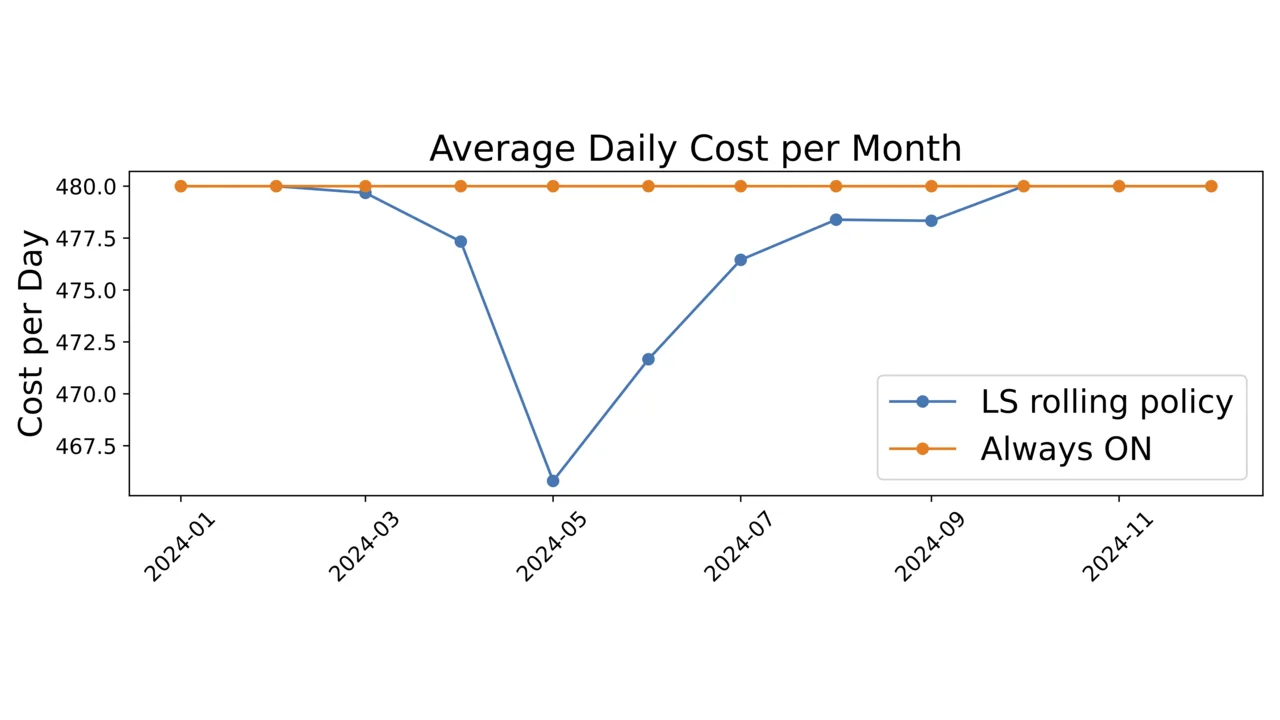
To address this, we formulate the problem as a stochastic optimal switching problem in which the delay is captured by an explicit warm-up clock added to the state. We develop a regression-based dynamic programming algorithm in the spirit of Longstaff and Schwartz, which tracks the clock on the control grid and approximates the conditional cost-to-go functions by Monte Carlo regression. On the theoretical side, we prove that the time-discretized dynamic programming problem converges to the value function of the original continuous-time control problem. On the applied side, the environmental dynamics are modeled by a forecast-tracking Ornstein–Uhlenbeck process calibrated month by month to real OpenWeather forecast and observation data, and the quality of the numerical solution is assessed through a primal–dual bound. The resulting feedback policies partition the space of temperature, humidity, and warm-up status into regions where the device can safely stay off and regions where it should be activated, and they make explicit how far in advance activation is needed to compensate for the warm-up delay. These risk maps are intended as one instrument among several for steering the device, giving operators a principled, forecast-informed indication of when switching off carries negligible risk. A rolling-horizon study on real Berlin weather data for 2024 demonstrates the full pipeline, from forecast uncertainty quantification to operational switching decisions.
For those interested in learning more about this work, the preprint is available here.
We are excited about the potential of this work as a decision-support tool for the operation of climate-control systems, and we look forward to further exploring and expanding upon this research. Stay tuned for more updates from our team!
ABSTRACT:
We consider a stochastic optimal control problem arising in the operation of industrial air-conditioning systems with delayed activation effects. The delayed transition between inactive and operational regimes induces a non-Markovian structure in the controlled dynamics. We derive a regression-based discrete dynamic programming algorithm on nested state-control grids. We give a probabilistic proof of convergence of the idealized time-discrete dynamic programming problem to the continuous-time value function. Numerical experiments based on calibrated multidimensional forecast-tracking Ornstein–Uhlenbeck models illustrate the effectiveness of the proposed methodology.