Article "Hierarchical Importance Sampling for Estimating Occupation Time for SDE Solutions" accepted for publication in Statistics and Computing
About
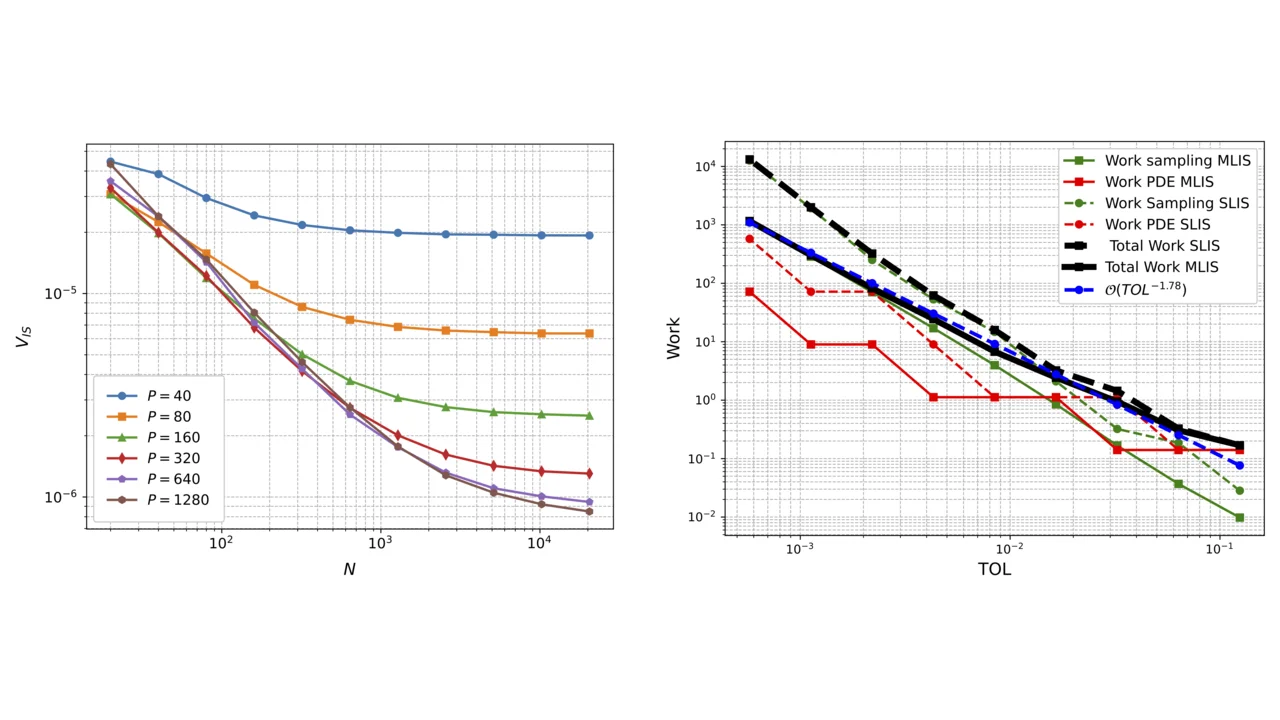
The article "Hierarchical Importance Sampling for Estimating Occupation Time for SDE Solutions" by Eya Ben Amar, Nadhir Ben Rached & Raúl Tempone was recently accepted for publication in Statistics and Computing, addressing the efficient estimation of rare-event probabilities associated with stochastic differential equations. This work develops an importance sampling approach based on stochastic optimal control and extends it to a multilevel framework, where the observed variance decay plays a key role in improving computational efficiency.
Key contribution: This article introduces a hierarchical importance sampling framework combining stochastic optimal control, smoothing techniques, and a novel common-likelihood formulation to improve variance decay and reduce computational costs. Numerical experiments demonstrate significant efficiency gains compared with single-level importance sampling.
Abstract:
This study considers the estimation of the complementary cumulative distribution function of the occupation time (i.e., the time spent below a threshold) for a process governed by a stochastic differential equation. The focus is on the right tail, where the underlying event becomes rare, and using variance reduction techniques is essential to obtain computationally efficient estimates. Building on recent developments that relate importance sampling (IS) to stochastic optimal control, this work develops an optimal single-level IS (SLIS) estimator based on the solution of an auxiliary Hamilton–Jacobi–Bellman (HJB) partial differential equation (PDE). The cost of solving the HJB-PDE is incorporated into the total computational work, and an optimized trade-off between preprocessing and sampling is proposed to minimize the overall cost. The SLIS approach is extended to the multilevel setting to enhance efficiency, yielding a multilevel IS (MLIS) estimator. Motivated by the zero-variance property of the ideal full-state continuous-time control, we study regimes in which the single-level variance decreases with refinement; this decay is assessed numerically for the implemented approximate control. This observation leads to the formulation of a necessary condition and a sufficient condition under which MLIS outperforms SLIS. To promote satisfaction of the sufficient condition, we introduce a smoothing of both the drift and the observable to enhance the variance decay rate, together with a novel common-likelihood MLIS formulation that is observed numerically to preserve this decay under IS. The classical multilevel Monte Carlo complexity theory can be extended to accommodate settings in which the variance on coarse levels depends on the target accuracy, a phenomenon for which the variance-decay behavior in the IS setting is a key example. Notably, the sampling work complexity of MLIS can be better than quadratic. Numerical experiments on fade-duration estimation demonstrate the effectiveness of the proposed approach and validate the theoretical analysis. In particular, the smoothing bias is estimated to be negligible relative to the prescribed tolerances, while the common-likelihood MLIS estimator achieves a substantial reduction in computational cost compared with SLIS.