About Marco Scavino Marco Scavino Visiting Scholar, Stochastic Numerics Research Group Stochastic Modeling statistics Marco Scavino is a Former Visiting Associate Professor from Universidad de la República, Uruguay, at Professor Raul F. Tempone's Stochastic Numerics Research Group at King Abdullah University of Science and Technology (KAUST). Research Interests Marco's research interests include Bayesian techniques for uncertainty quantification, statistical methods of experimental design, statistical procedures for model calibration, selection and validation, multivariate data analysis, statistical inference for stochastic processes, and stochastic modeling. Selected Publications A Laplace method for under Projects Related Projects 2014 Bayesian analysis of metallic fatigue data Tue, Apr 1 2014 - Mon, Feb 1 2016 Fatigue tests at different speeds (cycles per minute) all along a range of mean loads are performed to determine the fatigue strength of a certain kind of metallic specimen. Such experiments involve expensive destructive tests and are therefore carefully designed and applied. Bayesian inference for linear parabolic partial differential equations Sun, Jun 1 2014 - Thu, Jan 1 2015 Details We are currently developing hierarchical Bayesian techniques to infer the unknown coefficients in initial-boundary value problems (IBVPs) for linear parabolic partial differential equations. Finitely many noisy measurements of the solution field are made available, at a sequence of time points, in the interior of a domain of interest and for the boundaries. The main novelty of our approach to solving such class of inverse problems relies on the assumption that the boundary parameters are unknown and modeled by means of adequate probability distributions. Using the linearity of the
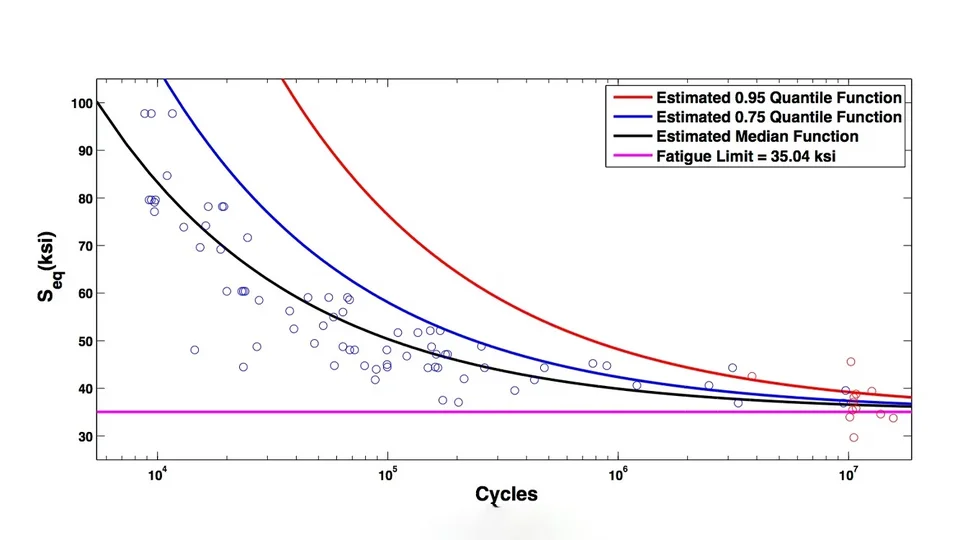
Bayesian analysis of metallic fatigue data Tue, Apr 1 2014 - Mon, Feb 1 2016 Fatigue tests at different speeds (cycles per minute) all along a range of mean loads are performed to determine the fatigue strength of a certain kind of metallic specimen. Such experiments involve expensive destructive tests and are therefore carefully designed and applied.
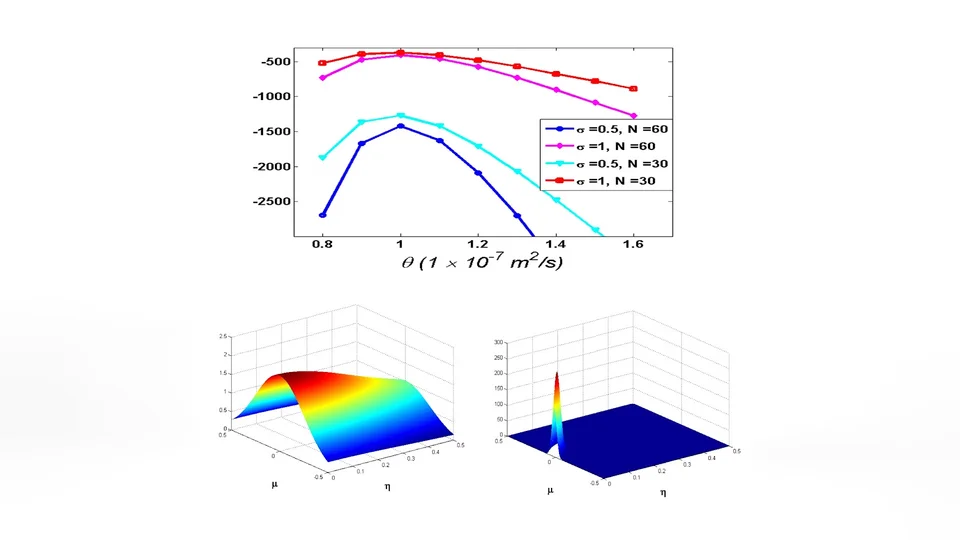
Bayesian inference for linear parabolic partial differential equations Sun, Jun 1 2014 - Thu, Jan 1 2015 Details We are currently developing hierarchical Bayesian techniques to infer the unknown coefficients in initial-boundary value problems (IBVPs) for linear parabolic partial differential equations. Finitely many noisy measurements of the solution field are made available, at a sequence of time points, in the interior of a domain of interest and for the boundaries. The main novelty of our approach to solving such class of inverse problems relies on the assumption that the boundary parameters are unknown and modeled by means of adequate probability distributions. Using the linearity of the